FAQ's

How much does it cost?
MUNA is completely free for student participants as they will be sponsored by a Rotary club. The cost for sponsoring a delegation is $350.00 per team of six students.
Will there be food?
Morning tea and lunch will be provided for each delegation and supervising teachers who have registered. Parents and Rotarians assisting with the event will also be catered for. Dietary needs and food allergies must be clearly communicated on the registration form. Tea and coffee will be available.
Are there prizes?
Every student will receive a certificate and a lapel badge for the country they represented, acknowledging their participation in the Rotary MUNA.
The following prizes will be awarded:
|
Title
|
Prize
|
Adjudication
|
|
Best Delegation
|
Medallions for each student
Certificates
|
Decided by the MUNA adjudicators
|
|
Best Delegation Runner-Up
|
Certificates
|
Decided by the MUNA adjudicators
|
|
Peace Prize
|
Medallions for each student
Certificates
|
Decided by the Secretary-General, Assembly President, Adjudicators, and Diplomatic Couriers
|
|
Best Country Dress
|
Certificates
|
Decided by the MUNA adjudicators
|
|
Encouragement Award
|
Certificates
|
Decided by the MUNA adjudicators
|
What are the key ‘Rules’ of the Model UN Assembly?
- That all delegates to the Assembly should faithfully represent the views and interests of their allocated country, rather than their own opinions.
- That the rules of debate should, to the extent possible, ensure all delegations representing UN Member states, participate in each assembly session.
- That in the interests of ensuring the maximum time possible for substantive debate, opportunities to influence the debate by procedural motions should be strictly limited.
- The Assembly shall consist of three debating sessions, each lasting 60 minutes. One resolution is debated in each session.
- Warnings are to be given 30 seconds before the expiry of speaking time for a four-minute speech and 15 seconds for a three-minute speech.
- Speakers are to stand in their place to address the Assembly and are to address their remarks to the Secretary-General- for example, “Secretary-General, Australia wishes etc.”
- Resolutions for debate and the order in which they are to be debated will be decided by members of the MUNA committee.
8. Diplomatic couriers help deliver written notes to other delegations, providing a discreet method of communication during the Model Assembly. Notes are placed on each delegate’s table. Delegates simply raise their hand with the note and a diplomatic courier will collect it and deliver it to the intended delegation.
9. It is not possible to amend resolutions. Delegates are encouraged to negotiate with each other to identify measures that could be adopted in the implementation of a resolution, or other inducements relevant to the resolution, that might encourage the support of other delegations for a particular position.
What is the expected general conduct in the Assembly?
The Model United Nations Assembly is a learning simulation designed to approximate the UN General Assembly. It is like a production in which delegates, and assigned officers, are actors following a script and directions. The MUNA script suggests delegates are not themselves, but ambassadors of the country they represent. It is not an opportunity for individual grandstanding, particularly where that might detract from the message you wish to transmit on behalf of your country. Show respect to fellow delegates and observe the ‘Spirit of MUNA’: act with dignity, decorum, and within the UN protocols.
Do students have to dress up?
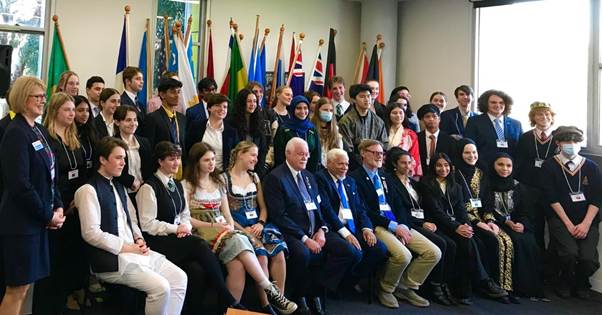
MUNA is not a costume party to ridicule or appropriate other cultures. Students are encouraged to respectfully dress in their allocated country’s formal clothes befitting the event. If not wearing national dress, students can dress semi-formal with black and/or white as the main colours. No jeans or casual wear is permitted in the Assembly.
Does MUNA support cultural diversity and inclusion?
MUNA adheres to the Rotary International Diversity, Equity and Inclusion policy, which embraces a culture that celebrates the contributions and inclusion of people of diverse backgrounds, regardless of age, ethnicity, race, colour, abilities, religion, socioeconomic status, culture, sex, sexual orientation, and gender identity.
How does Rotary ensure child safety at MUNA?
Rotary District 9815 strives to create and maintain a safe environment for all youth participating in Rotary activities. Rotary has strong child safe policies and records attendance of all adult attendees (Rotarians, school personnel, visitors, family and interested community members). Rotary District policies are available on our website.